
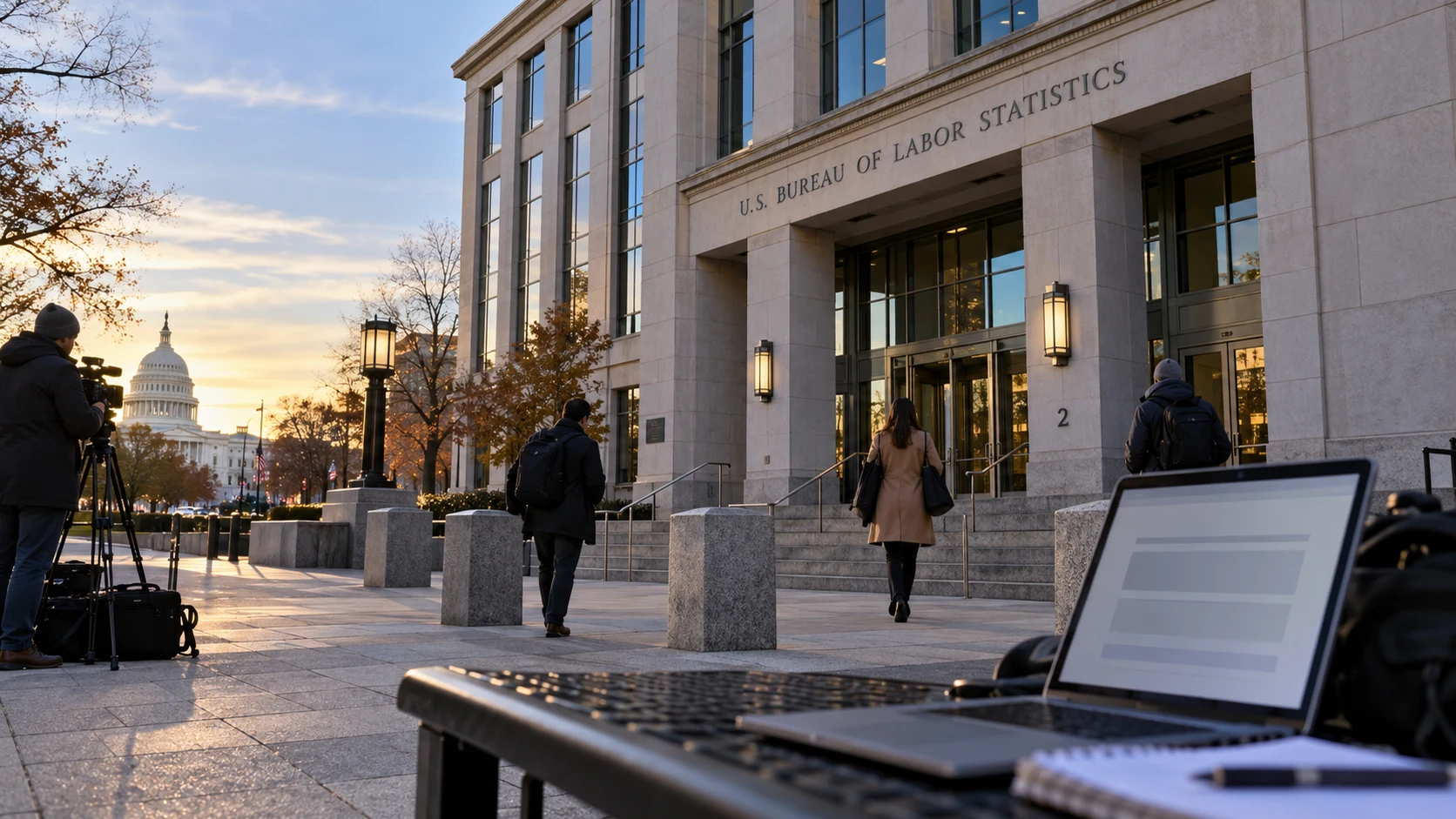



US Jobs Report 6 November 2026: Unemployment Rate Predictions
The next US jobs report is due on 6 November 2026 at 13:30 UK time. September's jobless rate was 4.2%. See how versus predictions on the October rate settle.
versus Editorial · 21 October 2026
The next US jobs report, the Employment Situation for October 2026, is due from the Bureau of Labor Statistics, or BLS, at 8:30am New York time on Friday 6 November 2026, which is 13:30 UK time (GMT). The last report, published on 2 October 2026, put the September unemployment rate at 4.2%, and at 07:05 UK time on 21 October 2026 the versus prediction on an October rate of exactly 4.2% showed 41.5p for Yes.
This guide is for readers in Great Britain, so all times are UK times. Every fact was checked at the BLS and the other official sources linked below on 21 October 2026; this is not a forecast of the October figure and not advice.
What the 2 October report said
The Employment Situation for September 2026 came out at 13:30 UK time (BST) on Friday 2 October. The BLS said both the unemployment rate, at 4.2%, and nonfarm payroll employment, up 29,000, changed little in September, and that the rate has stayed within 4.1% to 4.3% since March. The same release cut earlier payroll gains: July now shows a fall of 10,000 rather than a rise of 21,000, and August a rise of 133,000 rather than 162,000.
How the BLS arrives at the rate
The rate comes from the household survey, which the Census Bureau runs for the BLS on about 60,000 eligible households a month, according to the technical note; payroll numbers come from a separate survey of employers. Someone counts as unemployed if they had no work in the reference week (as a rule, the week that includes the 12th), could have started a job and had looked actively for one in the four weeks to the end of that week. The rate is the unemployed as a share of the labour force, which is everyone employed or unemployed.
The figure is seasonally adjusted, which strips out swings that recur every year, and it is printed to one decimal place. In September the adjusted rate was 4.2% and the unadjusted one 4.0%; only the adjusted figure counts for versus. The note also puts sampling error in numbers: with the rate around 6.0%, the 90% confidence interval for a one-month change in the rate is about plus or minus 0.3 percentage point.
Revisions differ by survey. The household survey applies new seasonal factors only to the latest month and revises five years of historical data once a year. Payroll estimates are revised in each of the next two reports, count as final after that, and are benchmarked once a year to unemployment insurance records.
Nine questions on one number
versus lists nine Yes or No predictions on the October rate: 3.8% or lower, 3.9%, 4.0%, 4.1%, 4.2%, 4.3%, 4.4%, 4.5% and 4.6% or higher. All nine read one figure: the seasonally adjusted U-3 rate for October 2026, the line in Table A-15 marked as the official unemployment rate, as the BLS first prints it. In September that line matched the headline rate. The seven middle predictions need the printed figure to equal their label, and the two at the ends take 3.8% or below and 4.6% or above.
The first print counts as soon as it appears, and the pages list their close as 13:30 UK time on 6 November; a later revision changes nothing. If no October rate is out by 8:30am New York time on Friday 4 December (13:30 UK time, GMT), when the November report is due, the most recent month published by then decides, against the same thresholds. The fallback has a real precedent: the BLS release of 16 December 2025 says household data for October 2025 were never collected during the lapse in federal funding from 1 October to 12 November 2025, so no October 2025 rate exists.
At 07:05 UK time on 21 October 2026 the pages from 4.0% to 4.4% showed these prices for Yes:
A price is the market's estimate of a chance, so 41.5p for 4.2% reads as a 41.5% chance that the deciding figure is exactly 4.2%. On each page the side that matches the deciding figure settles at 100p and the other at 0p, and because the nine are separate predictions, their prices need not add up to 100p (see how to read market probabilities).
Job openings come first
On Tuesday 3 November at 15:00 UK time (GMT) the BLS publishes JOLTS, its survey of job openings and labour turnover, for September, and five versus predictions on that total list their close at the same minute: under 6.8 million, 7.1 to 7.2 million, 7.2 to 7.3 million, 7.3 to 7.4 million and 7.4 million or more. Each reads the adjusted total in thousands rather than the rounded headline: the August release of 29 September said 7.1 million in its text but printed a preliminary 7,079 thousand in Table 1, which is below 7.1 million. A value on a boundary goes to the higher range, a total from 6.8 million up to just under 7.1 million falls outside all five, and if September is still missing at the next JOLTS release, on 1 December at 15:00 UK time, the latest earlier month published decides.
What happens between now and the December Fed meeting
- Sunday 25 October and Sunday 1 November: UK clocks go back (GOV.UK), then US clocks (NIST), after which 8:30am in New York is 13:30 in the UK.
- Wednesday 28 October, 18:00 UK time (GMT): the Federal Reserve's rate decision (Fed calendar), taken before any October jobs figure exists. It settles none of these predictions; see our guide to the Fed decision.
- Tuesday 3 November, 15:00 UK time (GMT): JOLTS for September, which settles the five job openings predictions only.
- Friday 6 November, 13:30 UK time (GMT): the October report (BLS schedule). Its first printed adjusted rate decides all nine unemployment predictions.
- Friday 4 December, 13:30 UK time (GMT): the November report. It revises the September and October payroll figures, which do not enter these predictions, and it is the fallback cut-off for the October rate.
- Tuesday 8 and Wednesday 9 December: the Fed's next meeting (FOMC calendar), the first after both the October and November jobs reports.
Before you trade
You can lose the whole amount you put into a position: the side that does not match the deciding figure settles at 0p. A 2% transaction fee is added on top of your stake and shown before you confirm. While a prediction is open you can sell at the current price, and a loss can never exceed what you put in. versus is licensed by the UK Gambling Commission under account 101143 (see its public register). Deposit limits, loss limits, time outs and self exclusion are in Safer Play.
Frequently asked questions
What time is the US jobs report on 6 November 2026 in the UK?
13:30 UK time (GMT), which is 8:30am in New York. UK and US clocks will both have gone back by then, so the usual five-hour gap applies.
What was the US unemployment rate in September 2026?
4.2%, according to the BLS release of 2 October 2026, with nonfarm payrolls up 29,000. The BLS said both changed little on the month.
Which figure settles the versus unemployment rate predictions?
The seasonally adjusted U-3 rate for October in Table A-15 of the Employment Situation, as first printed to one decimal place. Later revisions are ignored, and if no October rate is out by 13:30 UK time on 4 December, the latest published month counts instead.
18+ only. Trade responsibly. BeGambleAware.org and GAMSTOP.
Predict the world’s next moves.
enter versus™More frompulse

BC Election 24 October 2026: Date, UK Times and Predictions
21 October 2026

Israel Election 27 October 2026: UK Polling Times and Predictions
21 October 2026

Serbia Election 25 October 2026: Date, UK Times and Predictions
21 October 2026

Brazil Presidential Runoff 2026: Polls, UK Times and Predictions
17 October 2026

DeepSeek-V4.1-Flash-1017 Release Date and DeepSeek's Next Model
17 October 2026

GPT-7 Release Date: Astra 6.1, Terra 5.7 and What OpenAI Has Said
17 October 2026