
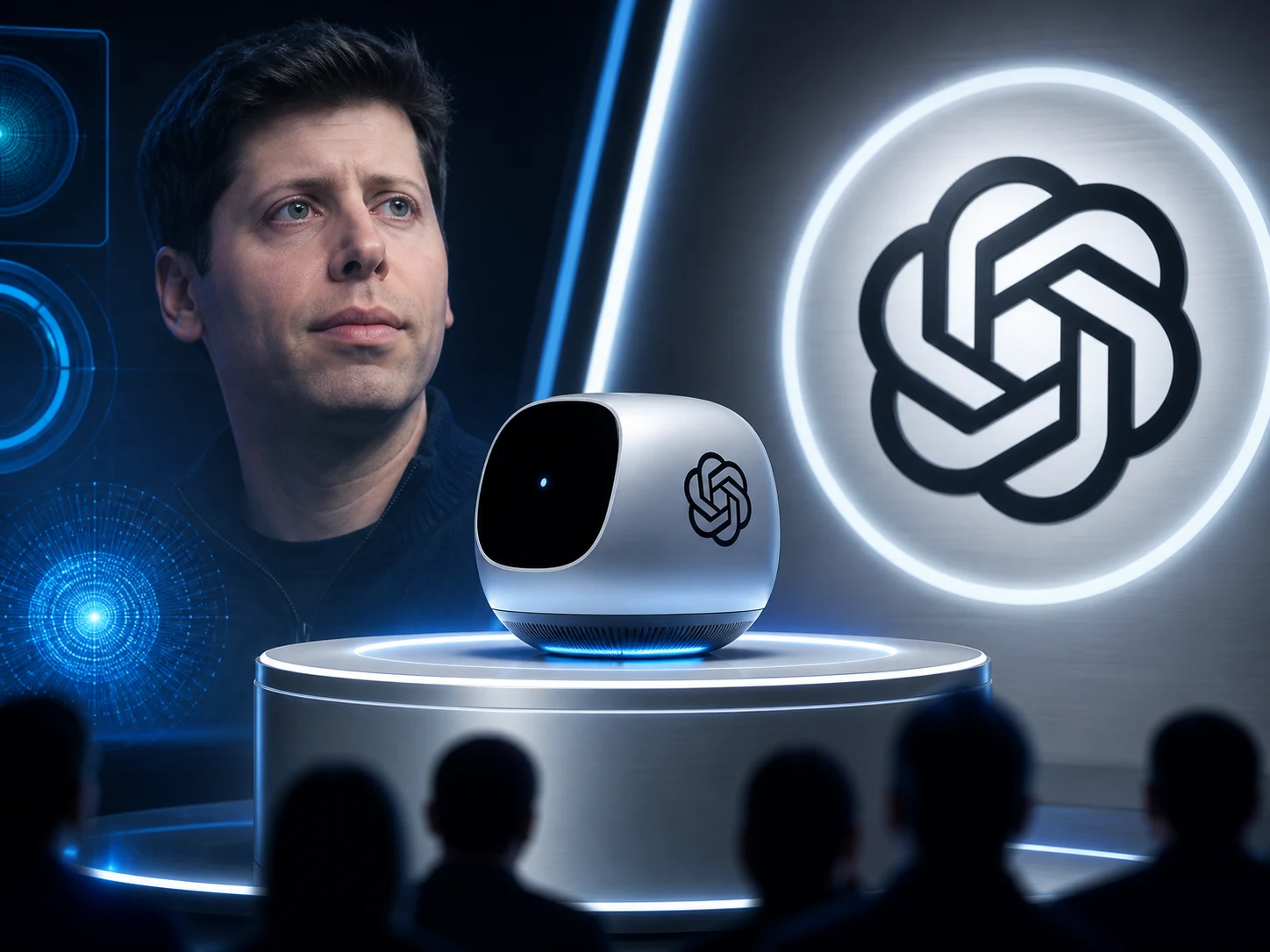



OpenAI First Consumer Device: Release Date and What Counts as a Launch
OpenAI’s website names no consumer device and gives no launch date. See what it has said, what counts as a launch on versus, and the dates to watch.
versus Editorial · 7 October 2026
As of 10 October 2026, OpenAI’s own website (openai.com) gives no launch date for a first consumer device and announces no such product, though its Supply Co. shop lists a keypad for people who use its coding tool Codex. The versus prediction on when OpenAI’s first consumer device will launch priced a qualifying launch by 31 December 2026 at 23.5p (a 23.5% chance) at 07:55 UK time on 10 October 2026.
What counts as a launch matters more than usual here, because the prediction needs a product that is both announced and generally available. This guide sets out what OpenAI has published, with dates, what would and would not qualify, and the dates to watch. A price on versus is the market’s probability estimate, between 0p and 100p: a winning contract settles at 100p and a losing one at 0p.
What OpenAI has said about consumer hardware
versus checked OpenAI’s newsroom and its other public pages on openai.com on 10 October 2026. The statements about devices that turned up, in date order, are these.
- 21 May 2025. In a letter signed by Sam Altman and Jony Ive, OpenAI said the team at io, the company Ive founded a year earlier with Scott Cannon, Evans Hankey and Tang Tan, would merge with OpenAI. Ive and the creative collective LoveFrom would take on design and creative responsibilities across OpenAI.
- 9 July 2025. An update on the same page said the io Products, Inc. team had officially merged with OpenAI, and that Ive and LoveFrom remain independent.
- 28 October 2025. OpenAI’s post on its new agreement with Microsoft says the agreement leaves OpenAI’s consumer hardware outside Microsoft’s rights to its intellectual property.
- 15 January 2026. OpenAI opened a request for proposals for US-based manufacturing, covering data centre inputs, robotics and consumer electronics (modules, tooling and final assembly). The deadline for proposals was June 2026.
- 25 August 2026. In a post on its compute strategy, chief financial officer Sarah Friar describes one system that spans data centres and chips, models, a developer platform, consumer and enterprise products, and “AI-native devices”.
None of these pages names a consumer product, describes one or gives a date for one. OpenAI has also published hardware news that is not about consumers. It unveiled a data centre chip called Jalapeño with Broadcom on 24 June 2026, and on 20 November 2025 it announced work with Foxconn on data centre racks.
DevDay 2026 took place in San Francisco on 29 September 2026. OpenAI’s recap lists more than 20 announcements across ChatGPT, Codex, models and agents, and versus found no hardware among them.
One device does appear on openai.com. The Work Louder page of OpenAI’s Supply Co. shop offers the Codex Micro, a keypad designed with the keyboard maker Work Louder, with a dial and a joystick, that works with Codex, OpenAI’s coding tool. It showed as out of stock on 10 October 2026 and carries no launch date. The rules exclude developer tools and do not name it, so only OpenAI’s own information would settle how it is classed.
What counts as a launch
The prediction’s rules are stricter than a headline. As they stood on 10 October 2026, in plain words:
- OpenAI’s own word counts. The prediction names OpenAI’s official information as the source that settles it, so reporting elsewhere is not enough on its own.
- Two steps, both required. OpenAI must announce the product publicly and the product must launch. The rules say an unveiling that stops short of general availability would not qualify, so a reveal that promises a release next year would fall short.
- A device for individuals. The product must be a physical device that people use directly, not a tool for businesses or developers. The rules give an AI wearable, a smart home assistant and an augmented reality device as examples.
- Not infrastructure. Developer tools, and AI chips and servers marketed only to businesses, do not qualify. Neither the Jalapeño chip nor the Foxconn racks described above would.
- Newly introduced. A rebrand, an update or a new version of a device that has already been released does not count. The only device versus found on openai.com is the Codex Micro keypad described above, so a new version of that keypad would not count, and nor would a relabelled device that another company released first.
The rules do not say how some cases would be treated: a pre-order window, a waitlist, an invite-only first batch or sales in a single country. The closest guide is the test they do give, general availability, judged from OpenAI’s own information. Read the rules on the prediction page before you trade.
How the two dates work
The prediction offers two answers, 31 October 2026 and 31 December 2026. Each asks whether a qualifying product has been announced and launched by that date. Under that wording, a launch before 31 October would satisfy both answers, a launch in November or December would satisfy only the second, and no launch by the end of the year would mean no on both.
The cut-off is 05:59 Central European time on the date, not midnight. European clocks go back on 25 October, so that is 04:59 UK time on both 31 October and 31 December. A launch on the afternoon of either date would miss that date’s cut-off.
What the price says
The 23.5p quoted above was the price of the 31 December answer at 07:55 UK time on 10 October 2026, and the 31 October answer stood at 1.5p, a 1.5% chance. In the month to 10 October, OpenAI’s pages did not name or date a consumer device.
Before you trade
A position can lose the whole amount you put into it, and while a market is open you can sell at the current price. Only trade with money you can afford to lose. versus is licensed by the UK Gambling Commission under account 101143. How it works follows a position from start to finish, and Safer Play covers the deposit limits, loss limits, reality checks, time out and self exclusion in the app. This guide is for readers in Great Britain.
Dates to watch
- 14 October 2026, 17:00 UK time (BST). A US federal court in San Jose is due to hear motions, including Apple’s request for a preliminary injunction, in Apple’s trade secrets lawsuit against OpenAI and others, according to the court’s own hearing calendar as it stood on 9 October 2026. The complaint concerns hardware development. A ruling could limit what OpenAI does with the material in dispute, but it would not settle this prediction, which depends on OpenAI’s own announcement and launch.
- 31 October 2026, 04:59 UK time. The first cut-off. If nothing qualifying has been announced and launched by then, the first answer resolves no and the 31 December answer stays open.
- 1 to 3 December 2026. OpenAI lists sessions at AWS re:Invent 2026 in Las Vegas on these days. The event is pitched at enterprises, so it is not an obvious stage for a consumer device.
- 31 December 2026, 04:59 UK time. The final cut-off in the rules. With no qualifying launch by then, both answers resolve no.
Beyond these dates, watch for an OpenAI post or livestream that names a device. OpenAI publishes in its newsroom, and its livestream page lists past streams only, with none upcoming on 10 October 2026. A named device would not settle the prediction by itself: what matters is whether OpenAI’s own words say it can be bought and used, or only that it has been shown. For other release-date questions, see our pieces on Gemini 4 and Kimi K4.
Two related predictions
versus lists two more predictions on the same subject. Will OpenAI bring out a consumer gadget by 31 Dec? uses the same announce-and-launch test, with a cut-off of 11:59 pm New York time on 31 December 2026, which is 04:59 UK time on 1 January 2027. Which product type will OpenAI unveil by 31 Dec? asks which kind of device OpenAI announces, from earbuds and glasses to phones and computers, and an announcement alone is enough there. Its cut-off is also 04:59 UK time on 1 January 2027. Read each prediction’s own rules before you trade.
Frequently asked questions
Has OpenAI announced a consumer device?
Not on its own website as of 10 October 2026. Its pages mention consumer hardware and AI-native devices in general terms, but none names a consumer product or gives a date. Its Supply Co. shop lists one device, the Codex Micro keypad for Codex users, shown as out of stock.
What is io, and what does Jony Ive do at OpenAI?
io is the company Ive founded with three co-founders. OpenAI’s letter of 21 May 2025 said its team would merge with OpenAI, and an update of 9 July 2025 said the merger had happened. Ive and LoveFrom remain independent and have taken on design and creative responsibilities across OpenAI.
Would an announcement alone settle the versus prediction?
Not this one. The product has to be announced and launched by the cut-off, and the rules say an unveiling that stops short of general availability would not qualify. The related prediction on product types is different: there an announcement is enough.
When is OpenAI’s next event?
DevDay 2026 already took place on 29 September 2026. The only upcoming event versus found on openai.com is OpenAI’s presence at AWS re:Invent 2026, with sessions listed for 1 to 3 December, and its livestream page shows no stream scheduled on 10 October 2026.
18+ only. Trade responsibly. BeGambleAware.org and GAMSTOP.
Predict the world’s next moves.
enter versus™More frompulse

Anthropic Fable 5.2 Release Date: What Is Known So Far
10 October 2026

Fed Interest Rate Decision 28 October 2026: UK Time and Predictions
10 October 2026

New Zealand Election 2026: Date, Polls and Who Is Expected to Win
10 October 2026

Sense and Sensibility 2026 Rotten Tomatoes Score: Is It Above 60%?
10 October 2026

Will the UK Fall Into Recession in 2026? ONS Data and Key Dates
10 October 2026

ECB Interest Rate Decision October 2026: Date, Time and Prediction
8 October 2026