
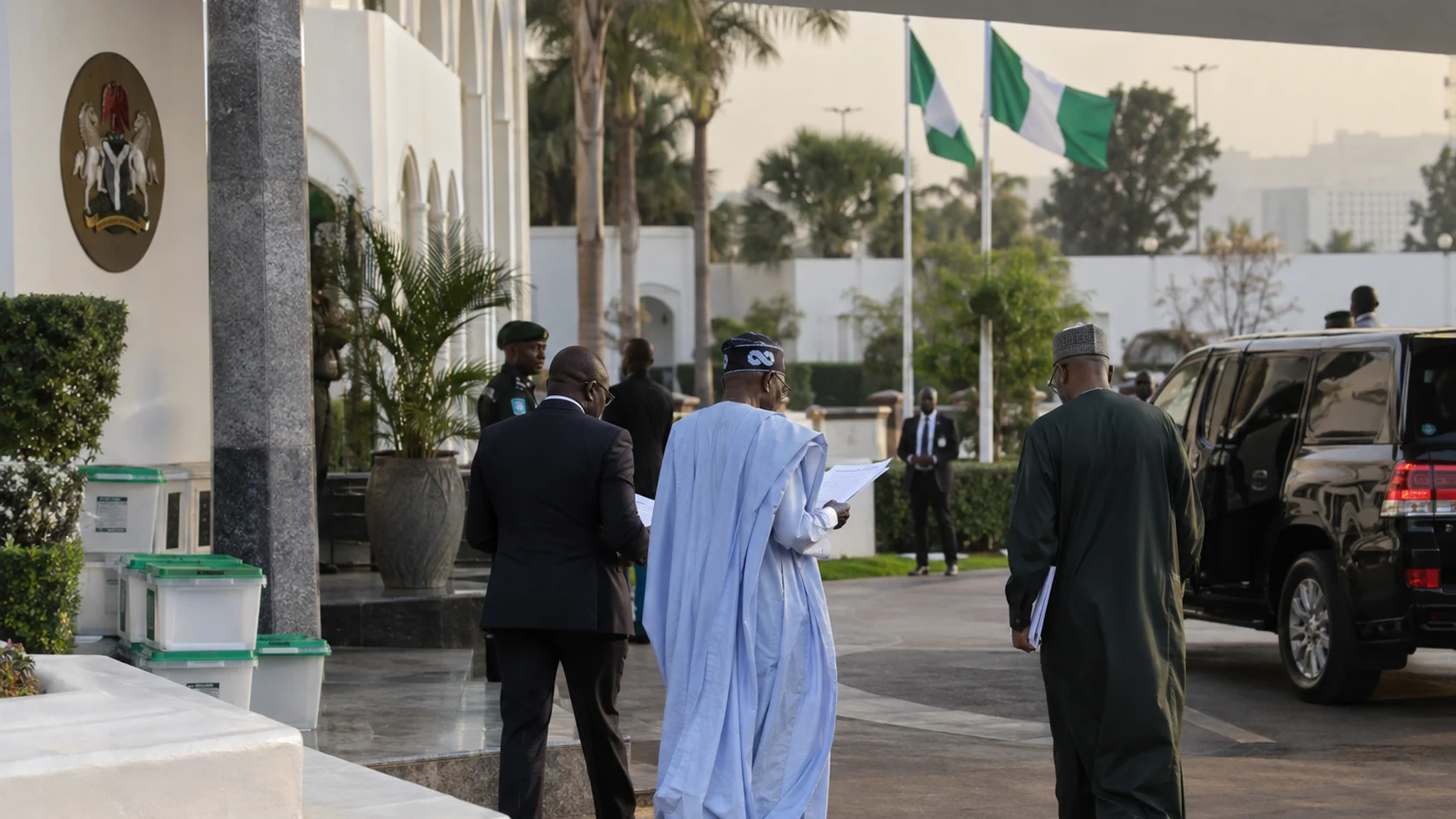



Nigeria Presidential Election 2027: Date, Candidates and Predictions
Nigeria votes for its president on 16 January 2027 and for governors on 6 February. INEC's candidate list, how a winner is decided and what versus asks.
versus Editorial · 15 November 2026
Nigeria is due to vote for its president and National Assembly on Saturday 16 January 2027, and for governors and state assemblies on Saturday 6 February, on the calendar of its Independent National Electoral Commission (INEC), which we read at 05:17 UK time on 15 November 2026. At 06:31 UK time on 15 November 2026, the versus prediction Who wins Nigeria's presidential race? showed 72.8p for Bola Tinubu, 23.6p for Peter Obi, 2.3p for Omoyele Sowore, 3.2p for Rabiu Kwankwaso and 1.4p for Rotimi Amaechi.
A price is the market's estimate of a chance, in pence out of 100: 72.8p reads as a 72.8% chance (how to read market probabilities). versus does not say who will win. This guide is for readers in Great Britain. Nigeria is an hour ahead of GMT all year.
Who is on INEC's presidential list
INEC's updated final list of presidential candidates is dated 31 October 2026. It has 19 rows, one per party. Eighteen name a presidential candidate and a running mate; the row for Accord (A) is blank and marked “court order”.
Three of the five names in the versus prediction are on that list as presidential candidates: Bola Tinubu for the All Progressives Congress (APC), Peter Obi for the Nigeria Democratic Congress (NDC) and Omoyele Sowore for the African Action Congress (AAC). The other two are running mates. Rabiu Kwankwaso, printed by INEC as Musa Mohammed Rabiu Kwankwaso, is Obi's vice-presidential candidate. Rotimi Amaechi, printed as Amaechi Chibuike Rotimi, is the vice-presidential candidate of the African Democratic Congress (ADC), whose presidential candidate, Atiku Abubakar, is not one of the five answers. The prediction's rules do not mention running mates: they give Yes to the listed person elected in the presidential vote, a second round included, and settle all five answers No if the winner is not among the five.
What a candidate needs to win
With more than two candidates, section 134 of the Constitution makes the winner the candidate with the most votes nationwide who also has at least a quarter of the votes cast in each of at least two thirds of all the States and the Federal Capital Territory. Without such a winner, the top scorer meets the remaining candidate with a majority in the most states, and a further election by simple majority follows if that fails. INEC's calendar lists no run-off date.
Under the Electoral Act 2026, as INEC publishes it, results are announced at the polling unit, then at ward, local government and state collation. For the presidency the returning officer is INEC's chairman, now Prof. Joash Amupitan, SAN, called the Chief Electoral Commissioner in the Act. He declares the winner at the National Collation Centre (sections 25 and 155), and a certificate for the winner follows within 14 days (section 72). INEC shows scanned polling unit result sheets on its IReV portal.
What the versus predictions ask
The main prediction has five answers and ends at 04:59 UK time (GMT) on Sunday 17 January 2027, which is 11:59 pm on 16 January in New York (what market resolution means). Reliable news reports decide where they broadly agree, and official results from Nigerian bodies such as INEC where they do not. With no definite result by 11:59 pm New York time on 31 October 2027 (03:59 UK time, GMT, on Monday 1 November), all five answers settle No.
Twelve Yes or No predictions cover seats, one per party and chamber for the APC, PDP, LP, NNPP, NDC and ADC. The Senate has 109 seats on our count and the House of Representatives 360 (Constitution, sections 48 and 49). Each asks whether the party wins more seats than any other on INEC's declared totals; only candidates standing under the party's own label count, and in a tie for the most seats the tied party whose abbreviation comes first alphabetically takes Yes. At 06:31 UK time Yes showed 85.6p in the Senate prediction for the APC and 7.8p, 1.5p, 3.1p, 4.2p and 7.3p in those for the PDP, LP, NNPP, NDC and ADC. In the House, Yes showed 84.5p in the prediction for the APC and 10.1p, 10.1p, 3.2p, 11.9p and 7.6p for the same five. All six are among the 22 registered parties on INEC's list, though the NNPP has no row on the presidential list.
More than 20 predictions cover governorship races, such as Lagos and Kano. They end at 04:59 UK time (GMT) on Sunday 7 February 2027, which is 11:59 pm on 6 February in New York.
Dates to watch, in UK time
INEC's pages give few dates. Voice of Nigeria reported on 27 February 2026 that INEC's revised timetable moved the elections from 20 February and 6 March 2027 to the dates below; INEC's statement of 14 August 2026 mentions that “revised” timetable, which we could not find on its site. “Our count” marks our own arithmetic from INEC's date and the Electoral Act 2026.
- Saturday 28 November: INEC's nationwide mock accreditation, which its chairman said on 12 November will simulate the presidential election.
- Tuesday 15 December: INEC says it will certify and publish the final register of voters. Its home page shows “93M+” registered voters, with no exact figure; its 2023 summary counted 93,469,008.
- Saturday 2 January 2027: the latest day for INEC's notice of poll, 14 days before voting (section 44; our count).
- By Friday 15 January: campaigns end 24 hours before polling day under INEC's 2026 rules for parties, which let them start 150 days before it, 19 August 2026 on our count.
- Saturday 16 January: voting from 08:30 Nigerian time (07:30 UK time, GMT) until 14:30 (13:30 GMT). The main prediction follows the person elected president, a second round included, and the seat predictions follow INEC's declared seat totals.
- Sunday 17 January, 04:59: end date of the main and seat predictions.
- If nobody qualifies: a run-off, which INEC's 2026 regulations (number 71) say the Commission must organise within 21 days. The main prediction counts a second round.
- Saturday 6 February: governorship and state assembly elections; the governorship predictions end at 04:59 on Sunday 7 February.
Before you trade
You can lose the whole amount you put into a position. A 2% transaction fee is added on top of the stake and shown before you confirm, you can sell at the current price while a prediction is open, and your loss can never exceed what you put in. versus is licensed by the UK Gambling Commission under account 101143 (public register), and Safer Play has deposit limits, loss limits, reality checks, time out and self exclusion, alongside GAMSTOP.
Frequently asked questions
When is the Nigerian presidential election?
Saturday 16 January 2027 on INEC's calendar, with voting from 08:30 to 14:30 Nigerian time (07:30 to 13:30 UK time, GMT). Governors and state assemblies vote on Saturday 6 February.
Who is running for president of Nigeria in 2027?
INEC's list of 31 October 2026 has 19 party rows, 18 of them with names, including Bola Tinubu (APC), Peter Obi (NDC), Atiku Abubakar (ADC) and Omoyele Sowore (AAC).
How many votes does a candidate need to win in the first round?
The most votes nationwide and at least a quarter of the votes in each of at least two thirds of the states and the Federal Capital Territory (Constitution, section 134). Otherwise a second election follows.
18+ only. Trade responsibly. BeGambleAware.org and GAMSTOP.
Predict the world’s next moves.
enter versus™More frompulse

Quito Mayoral Election 2026: Polling Day, UK Times and Predictions
20 November 2026
Louisiana House Runoffs 2026: Who Is on the 12 December Ballot
20 November 2026

Tasmania Council Election Results 2026: Who Was Elected Mayor
25 October 2026
Ontario Liberal Leadership Vote 2026: Who Will Lead the Party?
8 November 2026

Who Will Be Sweden's Next Prime Minister? The Riksdag Votes So Far
9 November 2026

Ljubljana Mayoral Election 2026: First Round Results and Runoff
1 November 2026